Brand and messaging
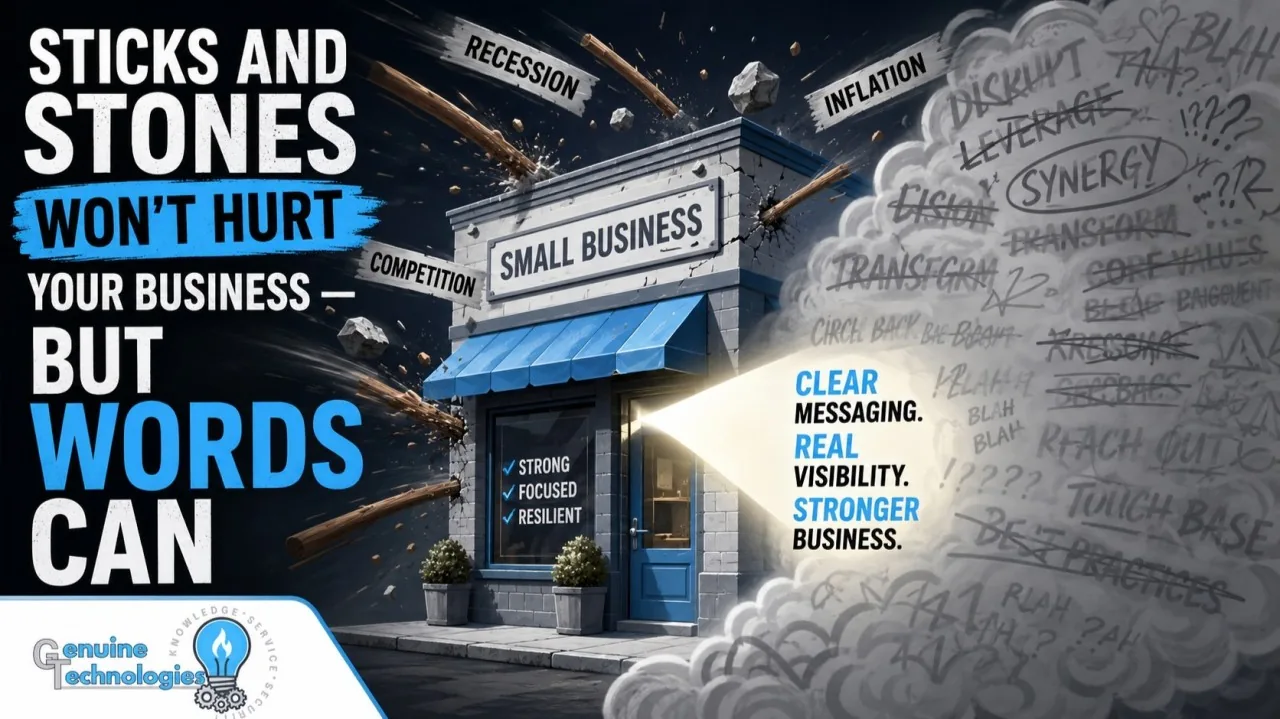
Sticks and Stones Won’t Hurt Your Business, But Words Can
Tough markets bruise good businesses. Vague messaging makes them invisible. How AI lets a small business sharpen its specificity, why words are infrastructure, and what microbrands change.
Key takeaways
- A resilient business can survive recessions, inflation, and competitors. It cannot survive being hard to understand.
- Every company now speaks to two audiences at once: the customer and the internet that connects the customer to you.
- AI changes the economics of specialization. One broad brand can become several sharp, focused points of entry.
- Words are infrastructure. They shape perception, guide discovery, establish relevance, and create trust.
Tough economic environments have a way of revealing what a business is truly made of.
When money tightens, customers become more selective. They ask harder questions. They compare more options. They delay decisions. They stop rewarding convenience alone and begin rewarding clarity, confidence, and obvious value.
These conditions can hurt. But good businesses can adapt to them.
They can cut costs. Change offers. Refine operations. Enter new markets. Reposition products. Find efficiencies. Become more disciplined. History is full of strong companies that have survived recessions, inflation, supply disruptions, changing technology, new competitors, and shifts in consumer behavior.
Sticks and stones, in other words. A resilient business can take a hit.
What it cannot afford is to make itself harder to understand.
Because there is no operational strategy that fully compensates for saying the wrong thing, using the wrong words, targeting the wrong audience, or failing to communicate clearly enough for customers to recognize why they should choose you.
The economy can bruise a good business. Bad messaging can make it invisible, as if it does not exist. Now that hurts.
Most business owners already understand the obvious danger of words. Say the wrong thing publicly and the consequences can be immediate: PR backlash, lost customers, damaged trust, legal exposure, internal conflict, or the expensive process of trying to save face.
But there is another kind of damage that is quieter, less dramatic, and far more common.
Not saying the right thing
It is not saying the right thing. Not clear. Not specific.
Even small choices, a phrase, a keyword, a hyphen, a plural, a location, the order of words, influence whether people and search engines understand what your business actually does.
Unlike a recession or a difficult market, this is not something happening to your business. It is something your business is doing to itself.
That matters because every modern company must communicate with two audiences at once.
The first audience is human: your prospective customer. They need to understand your value quickly. They need to know what you do, who you do it for, why it matters, and why they should choose you instead of the many other options available. Nielsen Norman Group’s long running eye tracking research shows people scan web pages rather than read them, so the words that carry your value have to be the first words they see.
The second audience is digital: the internet itself. Search engines, platforms, algorithms, directories, and AI powered discovery tools all need to understand your business well enough to connect you with the right people. Google’s own guidance on helpful content asks whether a page clearly demonstrates first hand expertise and answers the question a searcher actually has.
If your message is vague, your visibility becomes vague. If your language is broad, your traffic becomes broad.
That is what makes poor messaging so dangerous. You cannot out operate confusion. You cannot cost cut your way out of irrelevance.
Everything under one brand
A full service company wants to show every capability, every service, every product, and every possible customer type. The result may feel complete to the business owner, but confusing to the customer.
The brand becomes large, but blurry.
Blurry is expensive. Buyers have little patience for interpretation. They do not want to decode your value. They want to recognize it.
This is where AI is beginning to change the game; not by replacing the voice of the business, but by helping businesses organize and sharpen that voice with far greater precision.
The goal is not to let AI sand down your personality. The opportunity is to use AI to sharpen your specificity so everything you say is hyper focused on your target customer.
One increasingly powerful way to achieve this is by picking a niche; sometimes to the point of creating multiple focused microbrands from one broader parent company.
Imagine a car dealer that sells Jeep, Chevy, and Ford vehicles.
Under one large brand, the dealership can communicate variety. But under separate specialized brands, each message becomes sharper. One brand speaks directly to Jeep buyers; another to Chevy buyers; a third directly to Ford buyers. Each customer encounters language that feels closer to the exact thing they came looking for.
Now take the idea further. Instead of a Toyota dealership trying to be equally relevant for every Toyota model, imagine a specialized brand built specifically around the Toyota Corolla, Camry, or RAV4.
To someone searching for a Corolla, the specialist immediately feels more relevant than the generalist. The Corolla focused brand can speak directly about Corolla pricing, financing, comparisons, trade ins, maintenance, trims, reliability, and availability.
There is very little ambiguity about what that business wants to be known for, and who should get connected to them.
- The customer understands faster. They do not have to wonder whether the business can help them. The entire brand answers that question almost instantly.
- The internet understands faster. A tightly focused website, blog, video library, and content ecosystem sends consistent signals about what the business knows and what it offers. When page after page reinforces the same subject, the brand becomes easier for search engines, platforms, and AI driven discovery systems to categorize and connect with relevant users.
The larger competitor may have more authority overall, but the specialist has more relevance for one exact need. And increasingly, relevance is where business is won.
Using AI
Better wording is not merely a marketing exercise. It can become a competitive strategy. The obvious objection to this level of specialization is overhead cost.
Turning one broad brand into three, five, or ten focused brands sounds exhausting. Each one needs messaging, web pages, content, search strategy, media, offers, analytics, and maintenance. Historically, that degree of specialization could be expensive and difficult to manage.
AI changes these economics drastically.
A business can take the knowledge, services, customer data, FAQs, case studies, and expertise already inside the parent company and distill them into more specialized points of entry. AI can assist in developing service pages, keyword clusters, comparison guides, landing pages, email campaigns, video scripts, social content, FAQs, and educational resources, each aligned around a narrower customer need.
To be clear, the opportunity is not to create more content. The opportunity is to create clearer content. More specific content.
Instead of relying on one broad, ambiguous online presence, the company creates multiple focused points of entry. Each becomes a door for a particular customer with a particular need. The parent company gains reach not by becoming louder, but by becoming clearer and in more places.
One caution: Google’s spam policies specifically address doorway pages, which are pages created for similar queries that provide little additional value before sending users to the same destination. A microbrand earns its place only when it carries genuinely different expertise, offers, and answers for its audience.
And that brings us back to the larger point.
Good businesses adapt
They adjust pricing. Change processes. Find efficiencies. Revise offers. Fight through adversity. They can survive the sticks and stones.
But poor communication is different because it interferes with the very thing a business needs: visibility and customers understanding the business’s value.
It cannot assume customers will eventually figure it out. It cannot expect search engines, algorithms, or AI platforms to infer a specialty the company has never clearly articulated. It cannot expect the marketplace to reward value that has been buried beneath vague language.
Words are not decoration. Words are infrastructure.
They shape perception. They guide discovery. They establish relevance. They create trust. They determine whether a customer sees you as one of many possible options or as the obvious answer to a specific need.
So yes, sticks and stones may batter a business. A strong one will recover, if not take those sticks and stones and build an addition.
Words can do something far more dangerous than any of the ever changing economic conditions. Words can make a brand invisible. Words can hurt.
Want your brand to be the obvious answer?
Step 1 of our proven lead generation process is brand creation, strengthening, and spreading: the messaging that people and AI systems understand. Schedule a consultation.
Sources and further reading
- Google Search Central, Creating helpful, reliable, people first content: https://developers.google.com/search/docs/fundamentals/creating-helpful-content
- Google Search Central, Spam policies (doorway abuse): https://developers.google.com/search/docs/essentials/spam-policies
- Nielsen Norman Group, How Users Read on the Web: https://www.nngroup.com/articles/how-users-read-on-the-web/
- BrightLocal, Local Consumer Review Survey: https://www.brightlocal.com/research/local-consumer-review-survey/