AI strategy
Orchestration as a Service (OaaS): The Next Era of SaaS Won’t Be About Software at All
The next era of SaaS is about making everything work together. What an orchestration layer is, why most businesses underuse the software they already pay for, and the difference between generic AI and genuine AI.
Key takeaways
- Businesses do not want ten disconnected tools. They want as few platforms as possible that handle as much as possible.
- The SaaS market is splitting: simple tools are easy to replace, powerful platforms are hard to fully use.
- An orchestration layer combines agentic AI, vector databases, and workflow design to connect what you already own.
- Generic AI comes out of the box the same for everyone. Genuine AI is shaped around your workflows, data, and goals.
The next era of SaaS does not seem to be about adding more software. It is shaping up to be about making everything work together, and you can bet AI is playing multiple roles in this.
The most valuable SaaS products have become large ecosystems for a simple reason. Businesses do not want ten disconnected tools solving ten different problems. They want as few platforms as possible that handle as much as possible, quickly and easily.
At the same time, small, single purpose apps are becoming easier to recreate. In some cases, a team can reproduce their core functionality with a few AI prompts and a lightweight build.
The SaaS market is moving in two directions
- Simple tools are becoming easier to make and replace.
- Powerful platforms are becoming harder to use and to realize their full value.
A growing need for companies is someone, or something, to make it easy to connect the software, teams, data, and workflows they already have, along with the new tools, AI, and features that keep going on the shelf rather than into the workflow.
That is where a layer of AI can create real leverage, but it does not come out of the box that way.
Generic AI and Genuine AI
Generic AI is powerful, but it is still the same thing that comes out of the box for everyone. Genuine AI’s value appears when it is shaped around your workflows, software systems, data, constraints, decisions, and goals. It knows which of your systems or people can solve which problems, helping everything run quicker and smoother. More time and less work for you.
The next competitive advantage may not come from buying another platform. It may come from implementing a layer that connects what you already have, coordinates how it works, and leverages it all working together, making your software easy and simple to use to its fullest ability.
The best businesses will not simply have the best software. They will have the best orchestrated systems.
What is Orchestration as a Service?
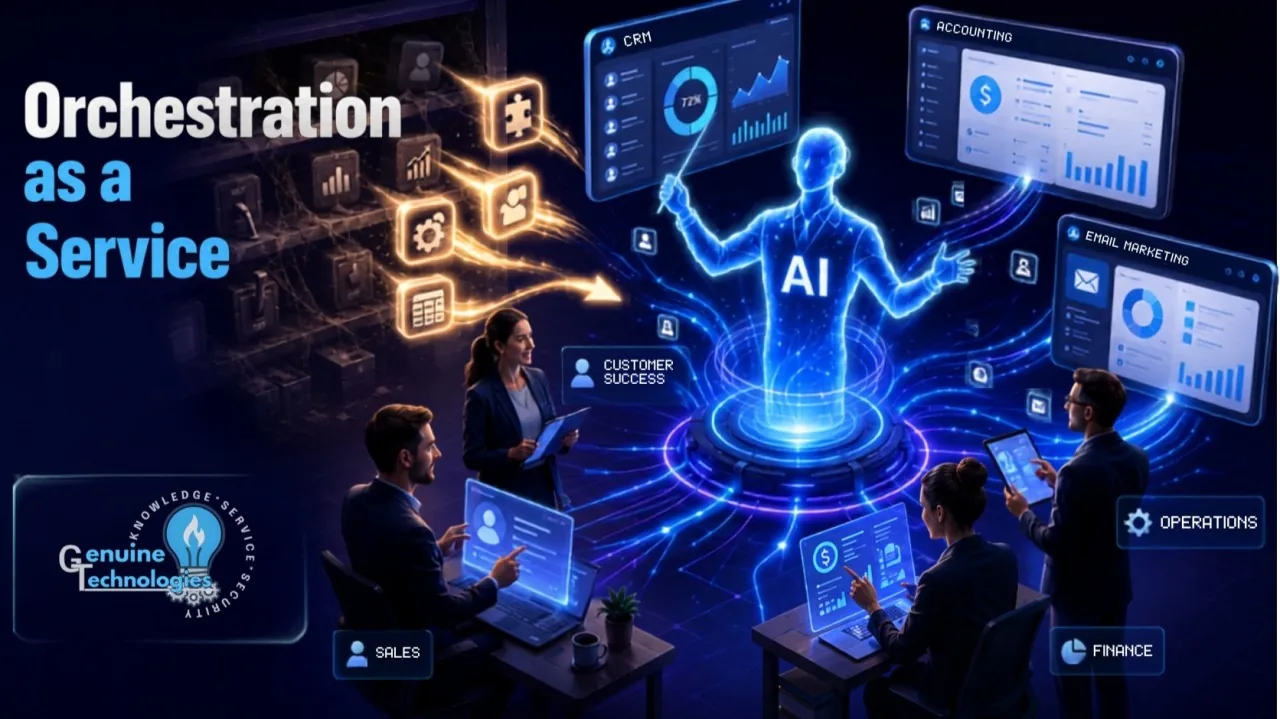
Siloed customer success teams at each SaaS product remain the deep product experts. Consultants and tech teams continue to be the liaison between those success teams and your multiple systems. An OaaS layer is added to become the bridge between the platforms, the departments, and the workflows of your business, and to connect them with the knowledge base and know how of consultants, tech teams, manuals, and past calls with various SaaS support teams.
An orchestration layer combines agentic AI, vector database architecture, and workflow design to integrate and understand how the different software systems connect to each other, learn how they work, and automate the handoffs between them. In many cases, it understands and can use the company’s software stack better than the people who use it daily.
In other words, even though many of the features integrated into an orchestration layer were already available, you can finally access and use them easily. Everyone gets upgrades that were technically always available but going to waste because they were too time consuming, too difficult to use, or never set up.
That matters because many businesses underutilize the software they already have. Software management studies from firms such as Zylo consistently find that a large share of purchased SaaS licenses go unused, and Gartner projects worldwide SaaS spending well above $300 billion a year. Their stack of capabilities keeps growing, but much of that value remains unused, disconnected, and becomes digital shelfware. It is some of the easiest to access, unrecognized value in your business. Think: do you have any software, or features of that software, that you are paying for but not using? There is value there if it can be made practical.
An orchestration layer uncovers the value of these features themselves, and the leverage they may have with your other programs. It takes underused or unused features off the shelf and puts them to use, simply by sending a message to an AI conductor.
The result is faster time to value from new technology and more value discovered from the technology your company already owns.
We will see if the term “OaaS” sticks, though.
Orbit is our orchestration layer
Orbit AI Helper works with HubSpot, Salesforce, monday.com, Zoho, Google Workspace, Microsoft 365, and Launch Platform. You tell Orbit what to do; Orbit works with your software to get it done.
Sources and further reading
- Gartner, Forecast: Worldwide public cloud end user spending: https://www.gartner.com/en/newsroom/press-releases/2024-11-19-gartner-forecasts-worldwide-public-cloud-end-user-spending-to-total-723-billion-dollars-in-2025
- Zylo, SaaS Management Index: https://zylo.com/saas-management-index/
- McKinsey, The economic potential of generative AI: https://www.mckinsey.com/capabilities/mckinsey-digital/our-insights/the-economic-potential-of-generative-ai-the-next-productivity-frontier